These Towhees are difficult to photograph, and it is funny that the best photo I got was when it landed on the curbing. Oh well, I’ll take it! [Grins].
Taken at Cave Creek Regional Park. Cave Creek, AZThis one was taken at Madera Canyon.
Canyon Towhees keep a low profile across their range in the Desert Southwest. These big, warm-brown sparrows are common on the ground and underneath shrubs in a variety of scrubby habitats, but they easily blend into the background. Look for a fairly long-legged, long-tailed sparrow that’s the same color as the dirt, with warm rusty brown under the tail. They look very similar to the widespread California Towhee (the two were once considered the same species), but their ranges don’t overlap.
Cool Facts:
Canyon Towhees are desert creatures and they pay attention to water supplies. They can nest twice a year, timing their attempts to coincide with winter and summer rains, which produce a flush of plant material and insects.
Canyon Towhees’ seemingly simple songs contain lots of variation and have been well studied. In 1968, two scientists described this variation colorfully: “At its worst, the song is a dull series of chips, but at its best, it is a gay, sustained jingle to be compared with that of a titmouse. A male whose dawn singing has been dull and perfunctory during late winter and early spring will become transformed into a polished singer when his mate disappears to incubate….”
Present-day Canyon Towhee and California Towhee were once considered the same species, named the Brown Towhee. Mitochondrial DNA, which traces genetic history along the mother’s gene line, provided the evidence needed to split the two species.
The oldest recorded Canyon Towhee was a male, and at least 7 years, 2 months old when he was recaught and rereleased during banding operations in Texas in 1998. He had been banded in the same state in 1992.
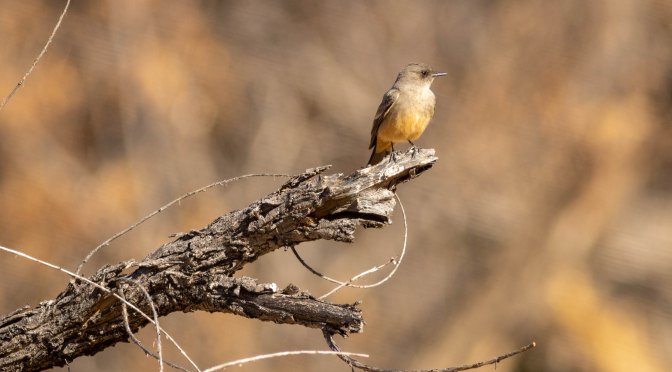
Say’s phoebe is a passerine bird in the tyrant flycatcher family. A common bird in the western United States, it prefers dry, desolate areas.
Behavior
Like other phoebes, Say’s Phoebes bob their tails. They perch on low shrubs or rocks and dart out to grab prey from the air, the foliage, or the ground. They can often be seen hovering low over fields looking for prey.
Diet
Say’s Phoebes’ primary diet is insects. They eat a number of terrestrial insects as well as the typical flying variety.
Fun Facts
The Say’s Phoebe breeds farther north than any other flycatcher, seemingly limited only by the lack of nest sites.
The numbers of this bird are declining, probably due to loss of habitat in its winter range. 😦
This bird was named for Thomas Say, the American naturalist.
A group of flycatchers has many collective nouns, including an “outfield”, “swatting”, “zapper”, and “zipper” of flycatchers.
I have a great time photographing the Say’s. It is amazing how close they let me get to them. I believe they are so focused on their prey they just ignore everything else.



 Wolf Song Blog