A few weeks ago Howard and I are having lunch at a restaurant in Carlsbad, New Mexico. We had been to this restaurant before and wanted to go again, because we enjoyed the food. The Red Chimney Pit Bar-B-Q has great food, service and atmosphere! It also has fish for me, the non-meat eater in the family.
When the waiter brings our food, he sets down a clear squeeze bottle filled with honey; its golden color was gorgeous. He stated, “This will be very good on your hot rolls.” We noticed the bottle of honey didn’t have a label or any other identification as to where it was bottled.
Of course we tried the honey on our hot rolls and enjoyed its delightful, mild and not-too-sweet taste. We later asked the waiter if the honey was bottled locally and he told us that it came from Roswell, NM.
Leaving the restaurant, after our delicious meal, we stopped at Albertsons (grocery) to pick up a couple gallon jugs of water. I decided to see what types of honey they sold. I found the isle where the honey was stored, but noticed all the bottles and jars were located on the very top shelf, which was too high for this 5’2” gal.
Howard and I tried to looked at the labels, but didn’t spot any that looked like it was bottled in New Mexico. I noticed a store clerk on the next isle over, so I when to ask him a few questions about the honey they sold.
I told him our story of eating the honey at the Red Chimney. He followed us back to the isle where the honey was and noticed the same situation, the bottles and jars were too high up to read the labels.
He then went to the back storage area and came out with a stool. He places the stool in front of the honey, climbs up and proceeds to read the labels. He tells us where each one is produced. He picks up one and states, “From New York, that won’t do!” Too funny, like the Picante Salsa ad!
Needless to say he couldn’t find a single honey product made in New Mexico. He seemed very interested in our honey treasure hunt. We thanked him and left the store with our jugs of water. When traveling I like to notice grocery items that are from the local area. Buy local the signs read!
The following day the weather at Brantley Lake State Park in Carlsbad was stormy so we decided to hang out in the warm coach. Howard’s interest was peeked, after our honey tasting at the restaurant, so he spend a few hours on the web reading all about Honey! Who knew there were so many different types of honey. However, he couldn’t find anything in reference to honey being bottled in Roswell.
We spent two nights at Brantley Lake State Park and early on the third morning we headed to Bottomless Lakes State Park in Roswell. We had a short ride! It turned out to be a nice day so we decided to take a ride out to Bitter National Wildlife Refuge (BWLR) to see what was going on out there. Here is their web-site: http://www.fws.gov/refuges/profiles/index.cfm?id=22510 (A great birding place.)
Before we headed out to the BNWF we stopped for lunch. I told Howard I was going to ask the waiter if he knew of any honey produced here in Roswell. Howard stated, “He won’t know anything about honey.” Boy was Howard wrong. I asked the waiter about the honey and he immediately smiled and stated, “Yes, I buy my honey from a local family here in Roswell.” He told us exactly where the place was located and all about the benefits of honey.
That morning arriving in Roswell, as we were traveling out to the state park, we passed a sign that had just the word Honey written on it. The sign was very old, faded in color and sat in front of a small stone building that was crumbling to the ground. We surmised this used to be the place where honey was sold.
Back at the restaurant our waiter told us exactly where we could purchase the honey. He then described the location and sign that we had seen. “No way” I said. I told him that can’t be the place, because the building is abandoned and falling down. He then said, “Look for a house near the sign, this is where you need to go.”
After our visit to the BNWR we knew we would pass the sign and decided to slowly drive by and look for the house. As we were passing we saw the house and an elderly man out in the yard; he was watering what looked like tomato plants.
I said, “Oh what the heck, lets stop and talk with him.” We pulled into the multi-car driveway just off the highway. Howard got out of the car and began a conversation with the grey-haired man. Howard then turned toward the car and waved me to come. The man stated, “Yes, I make and sell the honey, come inside and I will show you.”
We followed him inside his neat home, passing a guitar in the living room and headed to the kitchen. I could picture him sitting in his living room playing his guitar. He did look like an old hippy! He went to a big closet and came out with a quart jar of honey. He told us he only sells it by the quart for $12.00.
Howard with his newly acquired knowledge of honey asked him a few questions. No, it is not pasteurized; yes, it is 100% pure honey; yes it was bottled recently. Howard states, “Okay, we will buy a quart.”
The old, hippy, farmer stated, “Be sure to store your honey in a dark, cool place never putting it in the refrigerator and it will last a very long time.” He was so sweet and kind, shaking our hands when we left. I did find, on the web, a Roswell local Farmer’s Market that sells his honey. Here is the web-site: http://gravesfarmandgarden.com
We are now back at home, arriving Tuesday, and enjoying a teaspoon of honey in our morning coffee and afternoon hot tea! We have decided that the honey we purchased from this very nice elderly man is not the same honey we tasted in Carlsbad, but it is just as good.
Our quart of honey
How long does it take to use a quart jar of 100% pure honey?
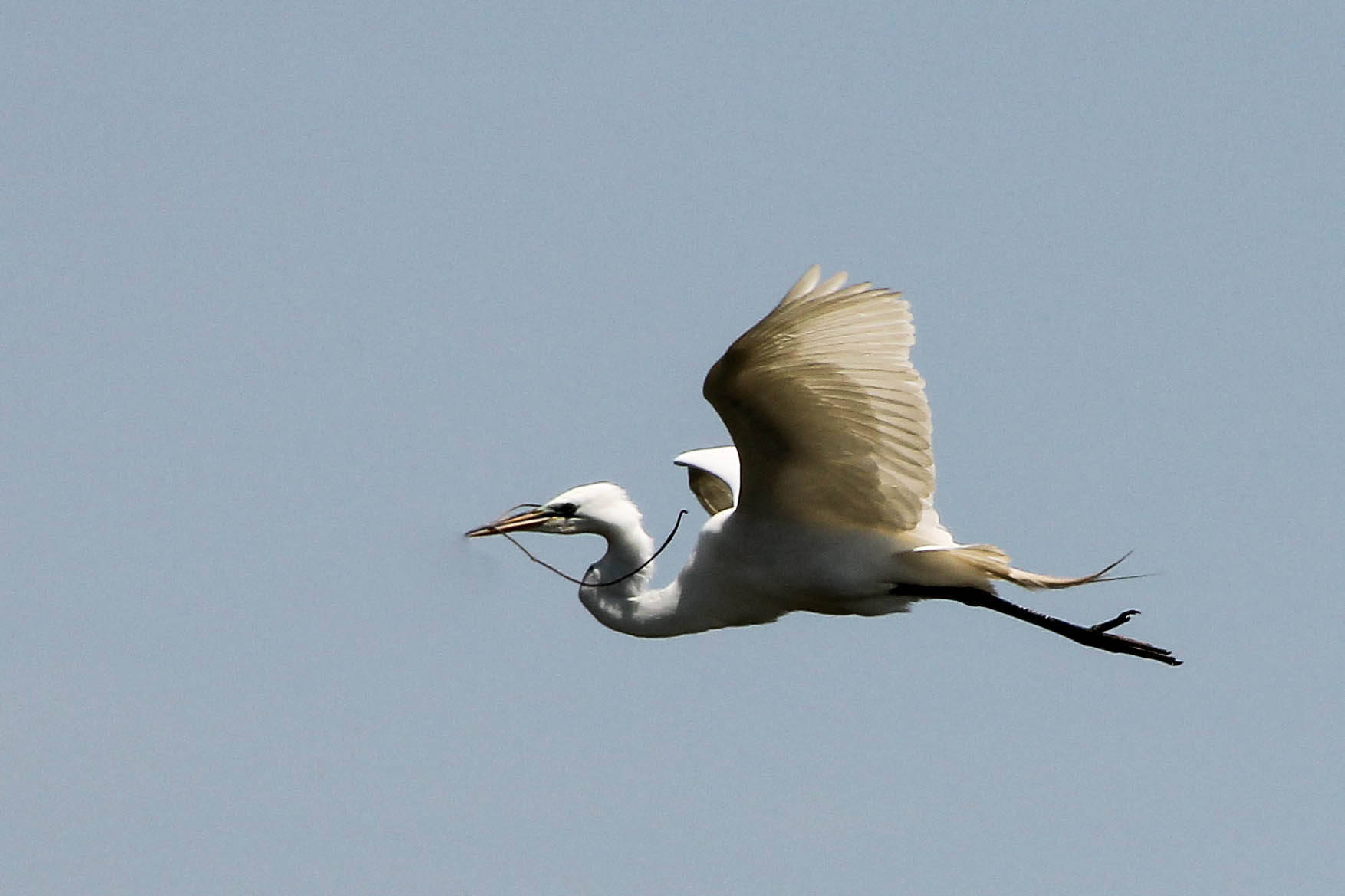
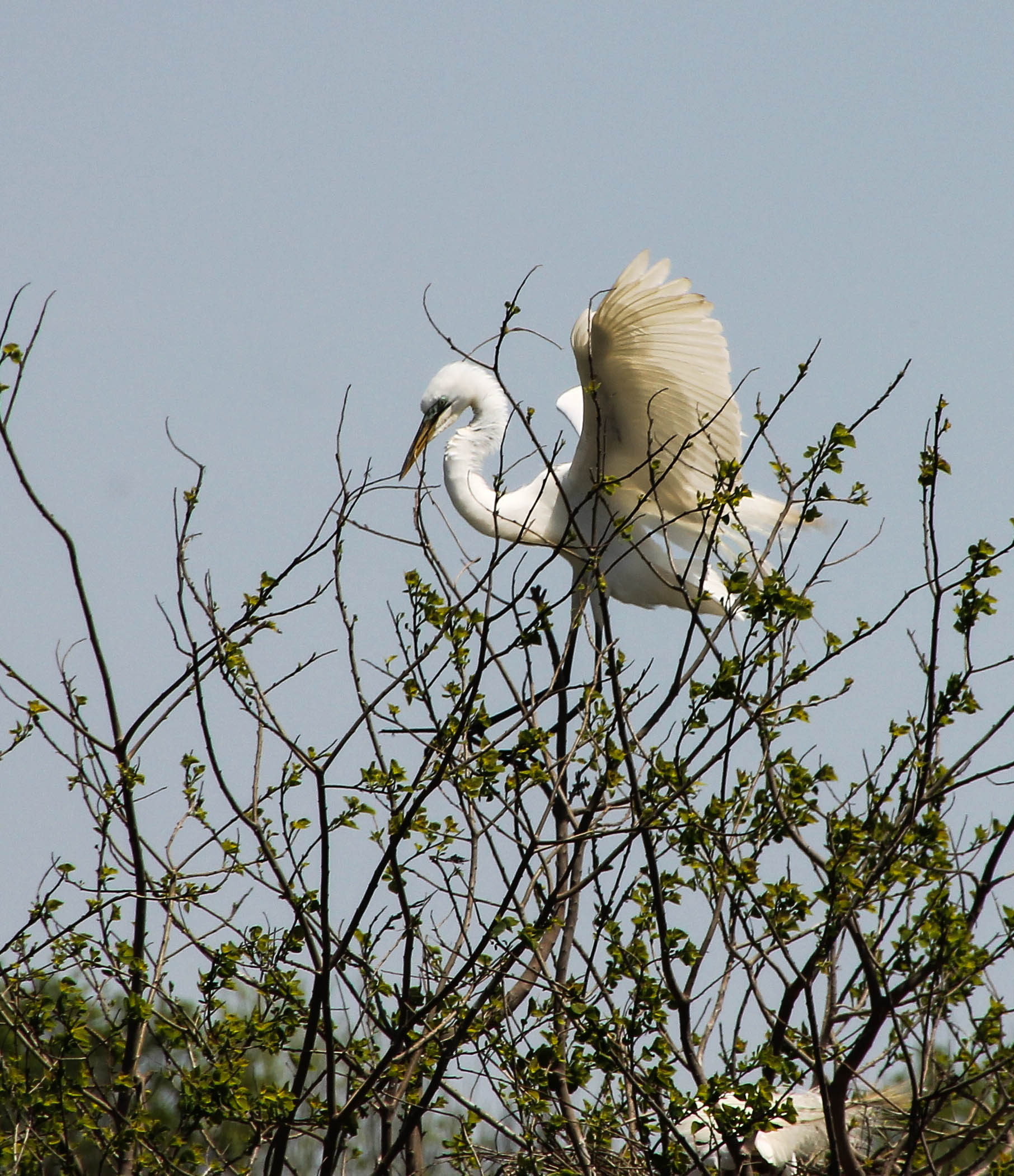
Hello, my name is Eugene. That is me in the photo above. In case you don’t recognize me I am a Great Egret. I am currently staying at the Smith Oaks Rookery in High Island, Texas.
Handsome, aren’t I
My mate, Louise, is in the photo below. Some people believe her name is Jeez Louise, because that is what I yell at her all the time.
Louise? You’re not Louise!
Louise, is always complaining about how I do things and when she starts nagging, I yell Jeez Louise, give me a break!
Louise, there you are, Jeez!
You see, Louise, complains about the sticks I find and bring her to build our nest; she complains about how I take off; how I land on the nest; what foods I bring her and the list goes on and on.
“I found one”I’am working hard LouiseHere Honey, I brought you another stickA beautiful landing if I say so myself“I’ll be back, going to find another stick”Whoa, lookout below!“I’am coming in backwards”
I am hoping it won’t be long, the chicks will be born and out of the nest and Louise will once again be a happy bird.
Aren’t we a lovely coupleThanks Eugene, for everything
While you are here, I would like you to meet some of my friends here at The Rookery.
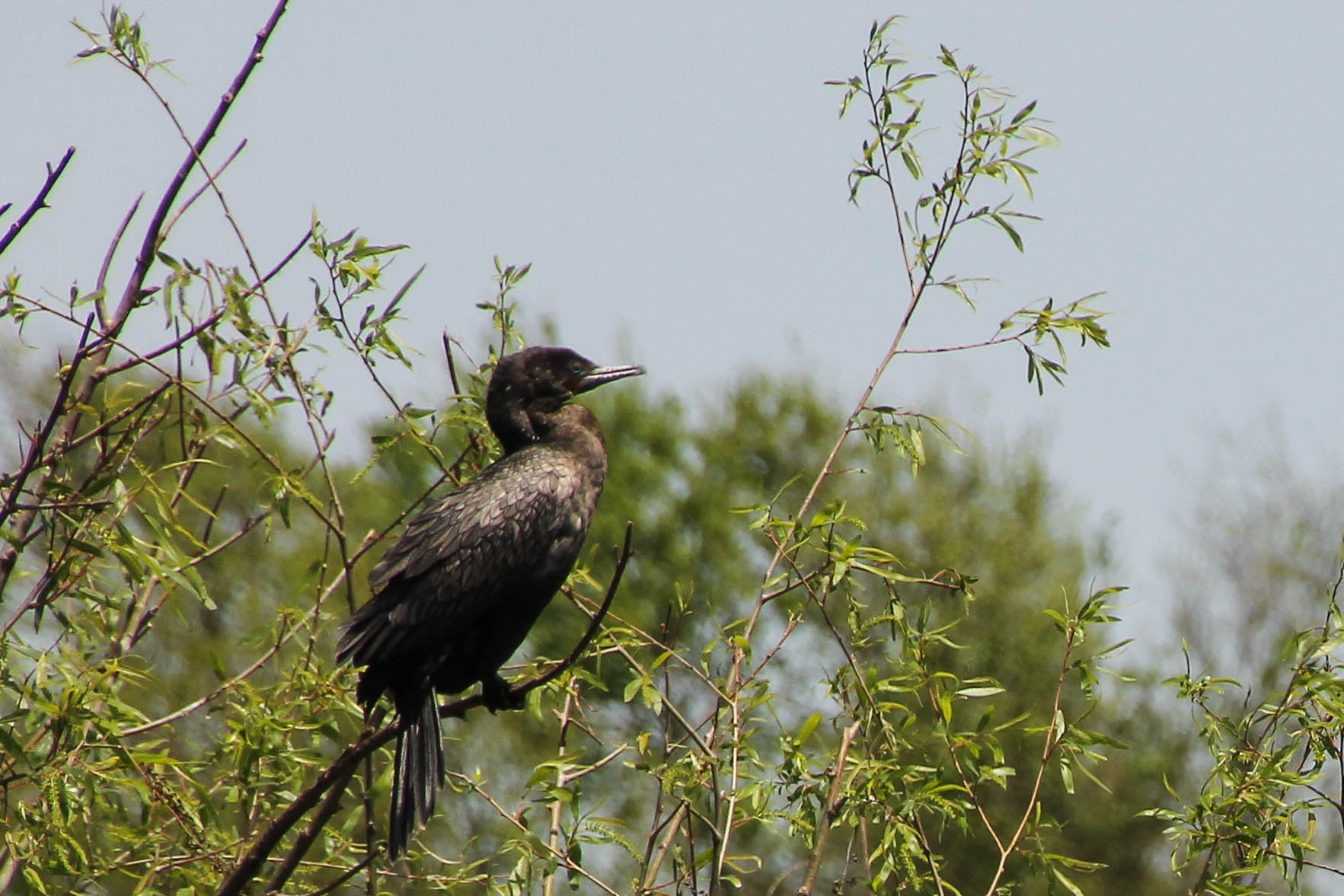
This is Captain, a Neotropical Cormorant. We should call him Shorty, because he has a very short tail, but that would be rude.
Meet The CaptainDon’t say anything about his short tail
Meet Showoff, a very handsome Snowy Egret who is always showing off his Yellow Slippers! The female Snowies are always after him. I’am jealous.
Meet ShowoffA Common Moorhen; get a load of the red shield!
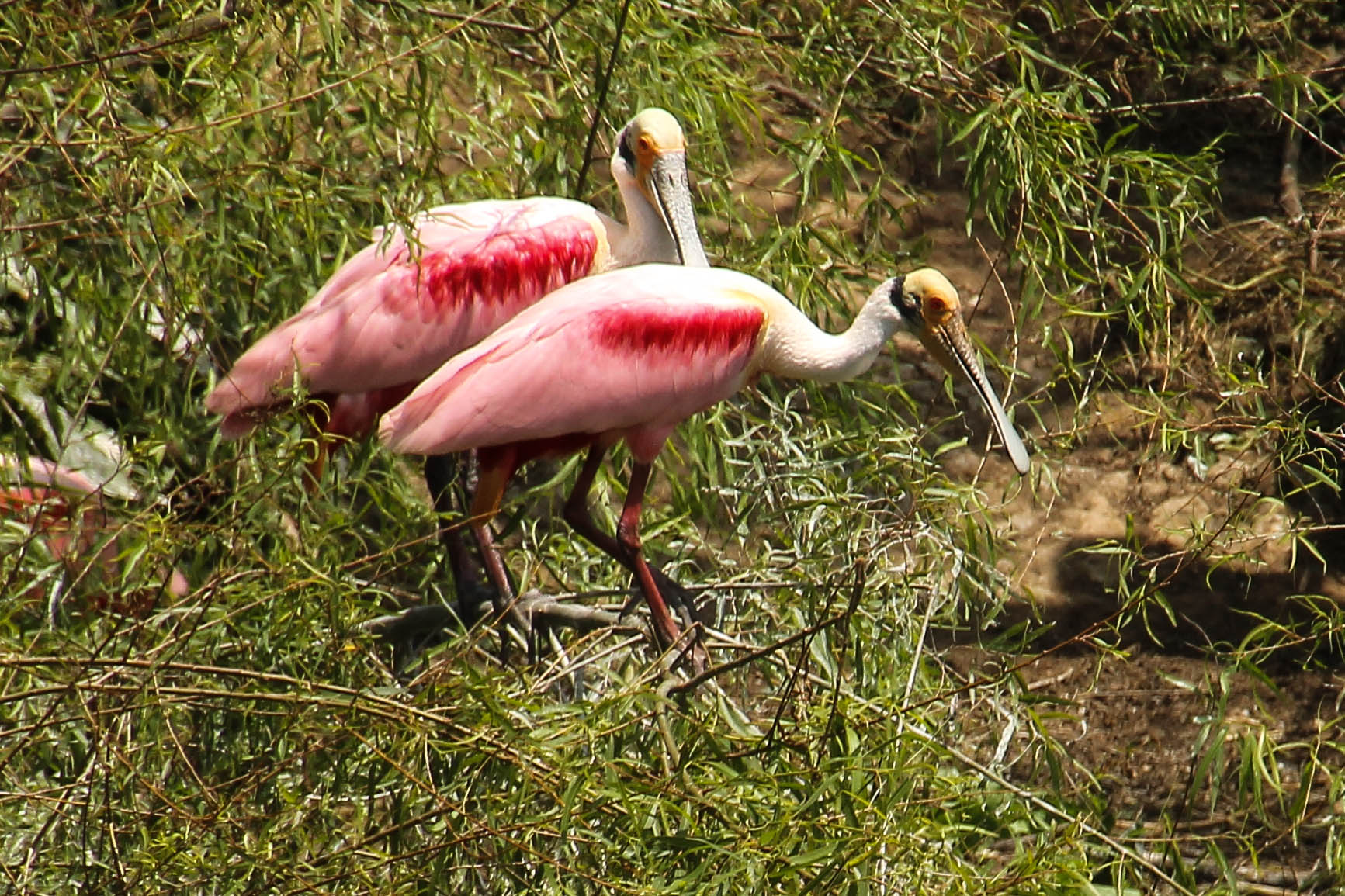
Our next door neighbors, here at the Rookery, are Samuel and Rose! They are called Roseate Spoonbills. Can you guess why? They are a lovely couple and they never yell at each other.
Meet Samuel and Rose
More, gossip, on them later.
“Some days, I just can’t get a grip on things”
Sheila here: Aren’t my friends lovely?
It was a thrill to visit the Smith Oaks Rookery in High Island, Texas. To see the number of nesting birds was incredible; I will never forget this day.
For information of this area please visit this web-site:
The rhythm of the coach tires rolling across the highway, through dry west Texas landscape, is a pleasing sound. The wheels on our faithful coach keep turing, bringing us closer to home and further away from family and our southern friends. For now it is a pattern of life we have chosen and one we are extremely happy living. Leaving is the natural way of things; this is how it is suppose to be, but still sad.
As I look out my side window at the stark beauty of the areas we pass, I can’t help thinking how fortunate we are to be able to travel. It is with happiness that we roll along talking about past experiences and planning new adventures.
Caught in Flight
We feel excitement when preparing to leave home, knowing we will see family and friends. We anticipate meeting new people along our route. We know we will feel delight in the discovery of different and beautiful places. We know fun times will be shared and fond memories created.
We also know our 2013/2014 winter trip is almost over.
At the end of October, 2013 we rolled out of Colorado, leaving home and friends behind. It is with excitement that early next week we will roll into our home town with friends to see, a stationary life to enjoy, projects to complete and of course new travels to plan.
On Friday, as we rolled along, we passed a sign. The sign made us both shout with joy. What did the sign say: You are entering Mountain Time Zone! Yes, our beloved Mountain Time Zone. Our bodies are once again in rhythm with our minds!! {grins}. Thank goodness for that! I asked Howard if he thought it would work if we just kept our clocks set to Mountain Time. What do you think?
A Pretty Face
Recent Travels:
As planned we left Beaumont, Texas on a Sunday, knowing that we would have to drive through Houston. We don’t like driving through Houston and choosing to drive this route at mid-mourning on a Sunday works best for us. Straight through driving on I-10, no problem! Another reason from leaving on a Sunday – it is the only way we can get reservations at Stephen F. Austin State Park. This park is located close to Houston and Katy and is a popular destination for local nature lovers, especially on the weekends.
We had a wonderful four days there and moved on to Kerrville, Texas staying at the Buckhorn Lake Resort. While there we ate some locally made Catfish Gumbo (always wonderful) and had the coach washed and waxed, which is the main reason for stopping in Kerrville.
Leaving Kerrville, we traveled less than sixty miles to South Llano State Park in Junction, Texas. As I have stated before, this is one of my favorite state parks. We met a lot of birders from all across the US and Canada. It is amazing how many people travel to Texas during this time of year to bird.
We also met some very interesting amateur and professional photographers and some astronomers. I am looking for a new lens to go on my Canon 70D so I spoke with some of these photographers to get their opinion on which lens to purchase.
After four wonderful days, it was sad leaving South Llano, because I enjoy the birding so much. We drove to Balmorhea and spent one night at Balmorhea State Park and then headed to Brantley Lake State Park in Carlsbad, New Mexico.
This is where we are through the Easter weekend, leaving tomorrow. We drove this route last year on our way home and enjoyed the area, so we decided to take this route again. A few flowers are blooming, but for the most part spring hasn’t fully arrived in this part of the west. We had hoped to walk around The Living Desert Wildlife Museum, but the weather is not cooperating, another time perhaps.
As I sit here, in my comfortable home on wheels, looking out across the prairie, I hear rain hitting on the roof, I see dark grey storm clouds rolling across the sky, driven by spring winds and I feel content.
The Rambling Rose, our home on wheels, keeps us happy and safe!
The Pileated Woodpecker – red crest extending from forehead to nape, large black bill, scarlet mustache, white chin, white line from base of bill crosses face to back of neck and extends down neck to side and has a solid black back.
~
Added to my Birding Life List on 09/21/98
(Beach Number Four, Washington)
~
Pileated Woodpecker (listening to me as I try to get closer to him)
Pileated Woodpeckers:
drum on trees and logs to claim territory and attract a mate
the male roosts in the nesting cavity before the eggs are laid and afterward, incubates them there at night
bore deep into trees, dig on the ground and on fallen logs for food
eat ants, beetles and a variety of other insects, acorns, beechnuts, seeds of tree cones, other nuts and various fruits
are common to fairly common in the Southeast
vulnerable to habitat loss and forest fragmentation
have adapted to habitat changes
compete for excavated nesting cavities with European Starlings
**information above taken from Smithsonian handbooks, Birds of North America**
“Now you see me, now you don’t!” (This is how I saw him most of the time.)
He stopped pounding on the log for a second.
Stephen F. Austin State Park
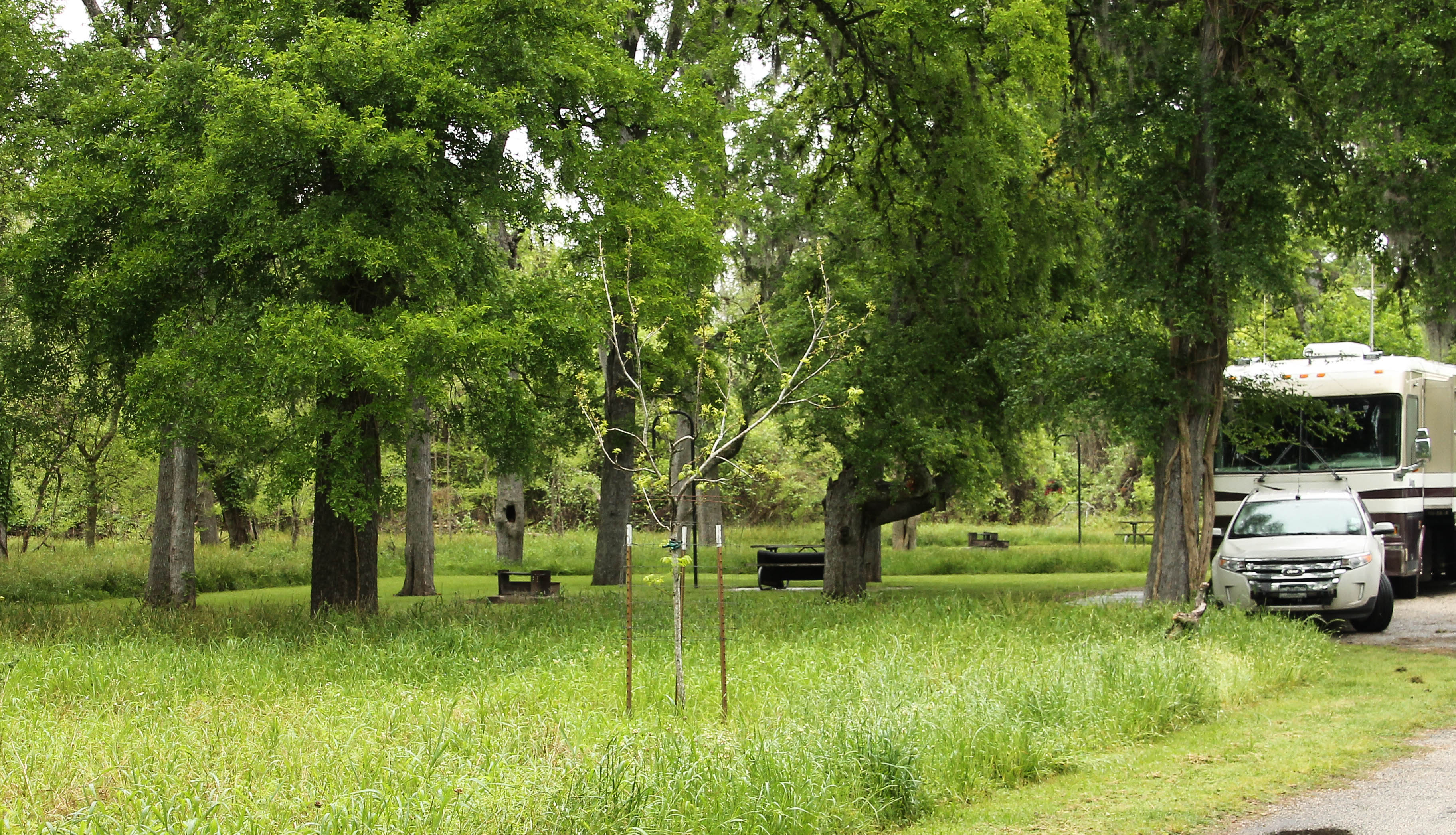
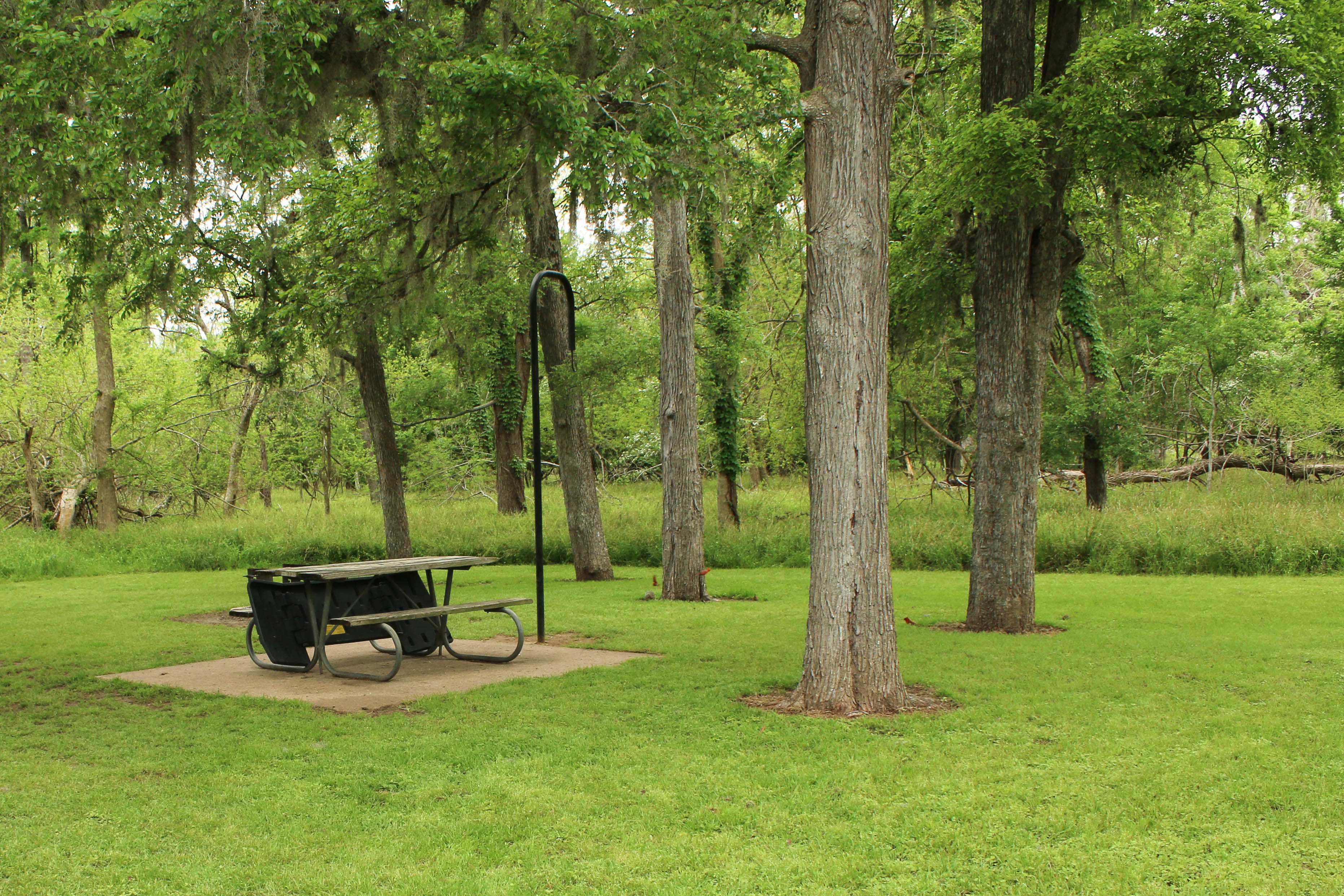
The photo above shows our backyard from April 6th to April 10th. This is a beautiful Texas State Park located in San Felipe, which is about 20 miles west of Katy, Texas and it is a terrific place to see birds.
While there we saw the Tufted Titmouse, Northern Mockingbird, Eastern Bluebird, Carolina Chickadee, Black Vulture, Red-bellied Woodpecker, Common Ground Dove, Wood Duck, Red-winged Blackbird, Chipping Sparrow, Carolina Wren, Mourning Dove, American Crow, Northern Cardinal and Indigo Bunting.
Our lovely and very green backyard for a few days. (Look close and you can see a few Northern Cardinals.)
Notice the felled trees in the background on the right of the photo above; this is where the Pileated was when we pulled into our site. It was a nice welcome!
Just as I am! Every Friday you may participate in Feathers on Friday at Prairie Birder.
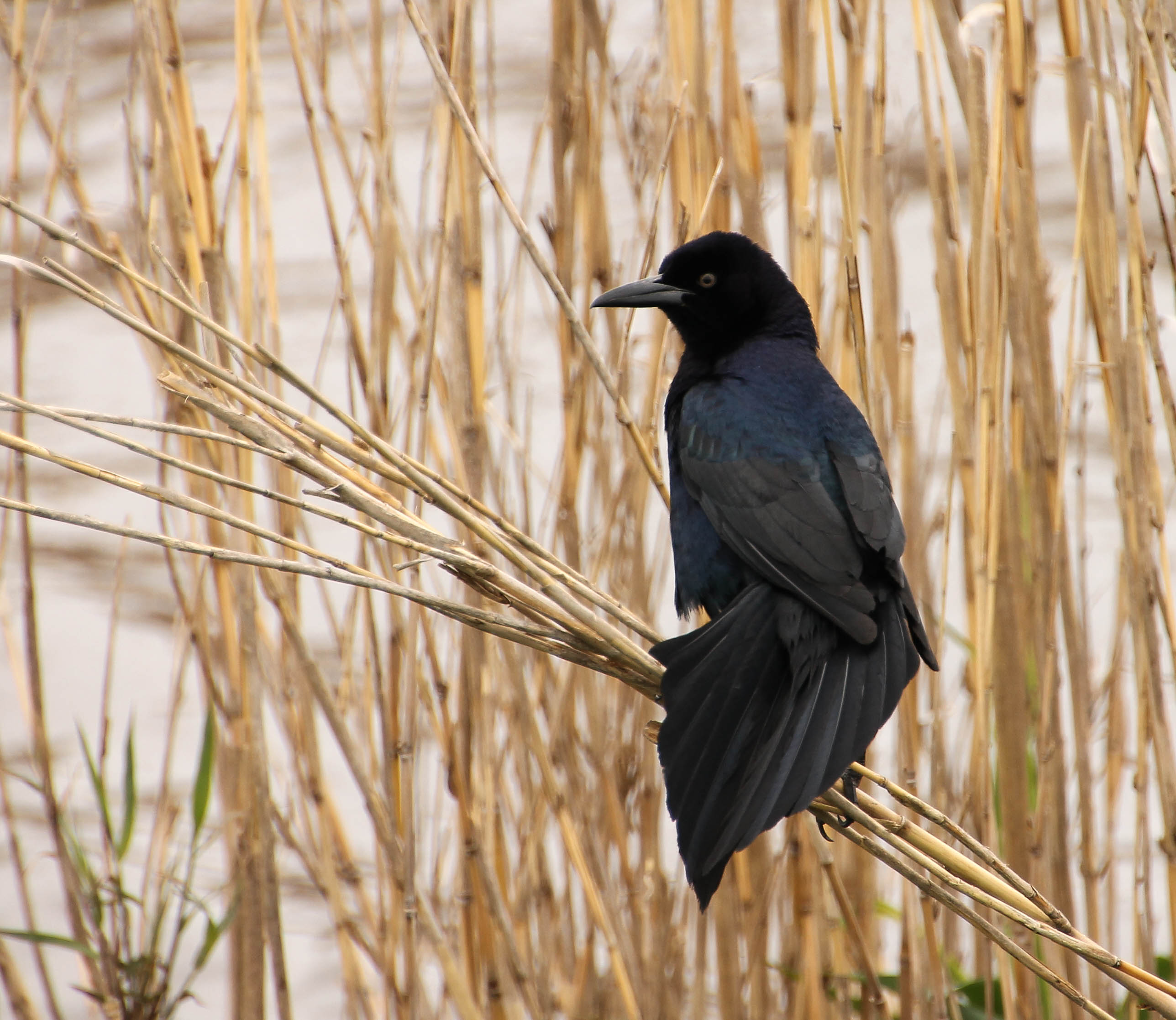
The Boat-tailed Grackle – brown or dull yellow eyes, long keel-shaped tail, black overall, iridescent purple on head and back, black legs and black bill.
~
Added to my Birding Life List on 04/10/93
(West Palm Beach, Florida)
~
The Boat-tailed Grackle is a very large, glossy black bird.
The Boat-tailed Grackle’s common name refers to its long tail, often held in a V-shape to form a “keel.”
Found along the coast from Texas to Long Island, this songbird prefers salt and brackish marshes, where it breeds in colonies and socializes in noisy flocks.
The Boat-tailed Grackle has been expanding its range northward since the 1940’s, probably due to milder winters north of the Carolinas.
The female is a light, warm brown with dark brown wings and tail. The female’s “ear” is darker brown under a pale eyebrow. The eyes of both sexes are yellowish.
Boat-tailed Grackle
I photographed this beautiful bird while visiting the Anahuac National Wildlife Refuge this past week.
What a beautiful black bird
Just as I am! Every Friday you may participate in Feathers on Friday at Prairie Birder.











 Wolf Song Blog