I was looking at my posts today and discovered I started this post on the Black-crested Titmouse last year, but didn’t publish it.
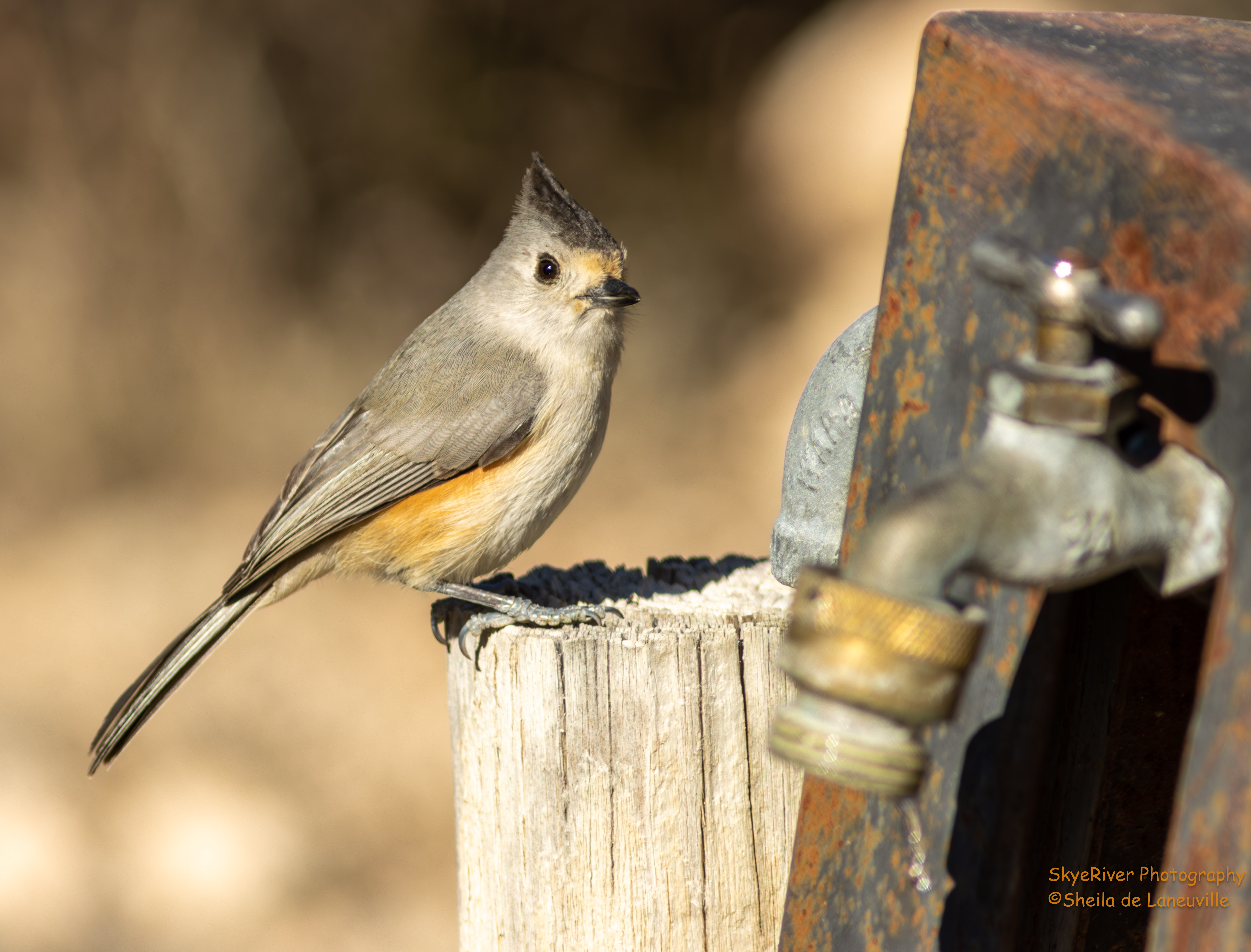
The Black-crested Titmouse or Mexican titmouse, is a passerine bird in the tit family Paridae. Once considered a subspecies of the tufted titmouse, it was recognized as a separate species in 2002. It is native to southern Texas, Oklahoma, and east-central Mexico.
~Photos taken January 17, 2024 at South Llano State Park
While on a walk I came upon this cute Black-crested Titmouse as it seemed to study this faucet. With the South Llano River very close, I had to wonder why this Titmouse felt it necessary to try and drink from this faucet. It might have been just easier. The river water might not have been easily accessible. If I remember right it was pretty cold and this faucet might have been turned on to drip to keep the pipes from freezing. It sure gave me a smile and made a fun photo.
These guys are hard to capture, because they don’t stay still for very long. I got lucky because it was determined to get a drink.
Well done!
Quote:
“Intelligence without ambition is a bird without wings.” Dali
Lincoln’s Sparrow – South Llano River State Park – April 2022
A pretty Lincoln’s Sparrow visiting one of the bird blinds in South Llano River State Park. I think Sparrows are pretty with their many unique and colorful patterns. They can be a challenge to identify, which makes it even more fun.
A few facts taken from the web: The dainty Lincoln’s Sparrow has a talent for concealing itself. It sneaks around the ground amid willow thickets in wet meadows, rarely straying from cover. When it decides to pop up and sing from a willow twig, its sweet, jumbling song is more fitting of a House Wren than a sparrow. Though its song might conceal its sparrowness, its plumage says otherwise. This sparrow looks as if it is wearing a finely tailored suit with a buffy mustachial stripe and delicate streaking down its buffy chest and sides.
Males defend their territories with song and will threaten intruders with buzzing calls and wing-flapping. When the female is ready to mate, she approaches the male and flutters her wings the way a juvenile bird begs for food. They form monogamous pair bonds during the breeding season, but they do not maintain those bonds the rest of the year. Once on the nest the female is especially secretive. When disturbed, she slips quietly off the nest and runs mouselike with head down through the vegetation for several feet before flying up off the ground.
During migration Lincoln’s Sparrows often associate with other sparrows, including White-crowned, Song, and Swamp Sparrows. In the winter they are usually solitary, but sometimes forage with small groups of other sparrows.
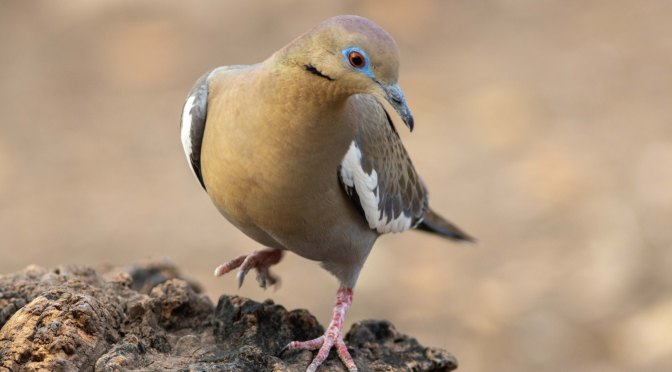
Back in April while camping at South Llano River State Park, I photographed these White-winged Doves.
The white-winged dove is a dove whose native range extends from the Southwestern United States through Mexico, Central America, and the Caribbean. They are large for doves, and can be distinguished from similar doves by the distinctive white edge on their wings. They have a blue eyering, and red eyes.
On this day, as we remember our fallen heroes, and as we show pride for our free and beautiful country, I hope you have peace in your hearts.






 Wolf Song Blog