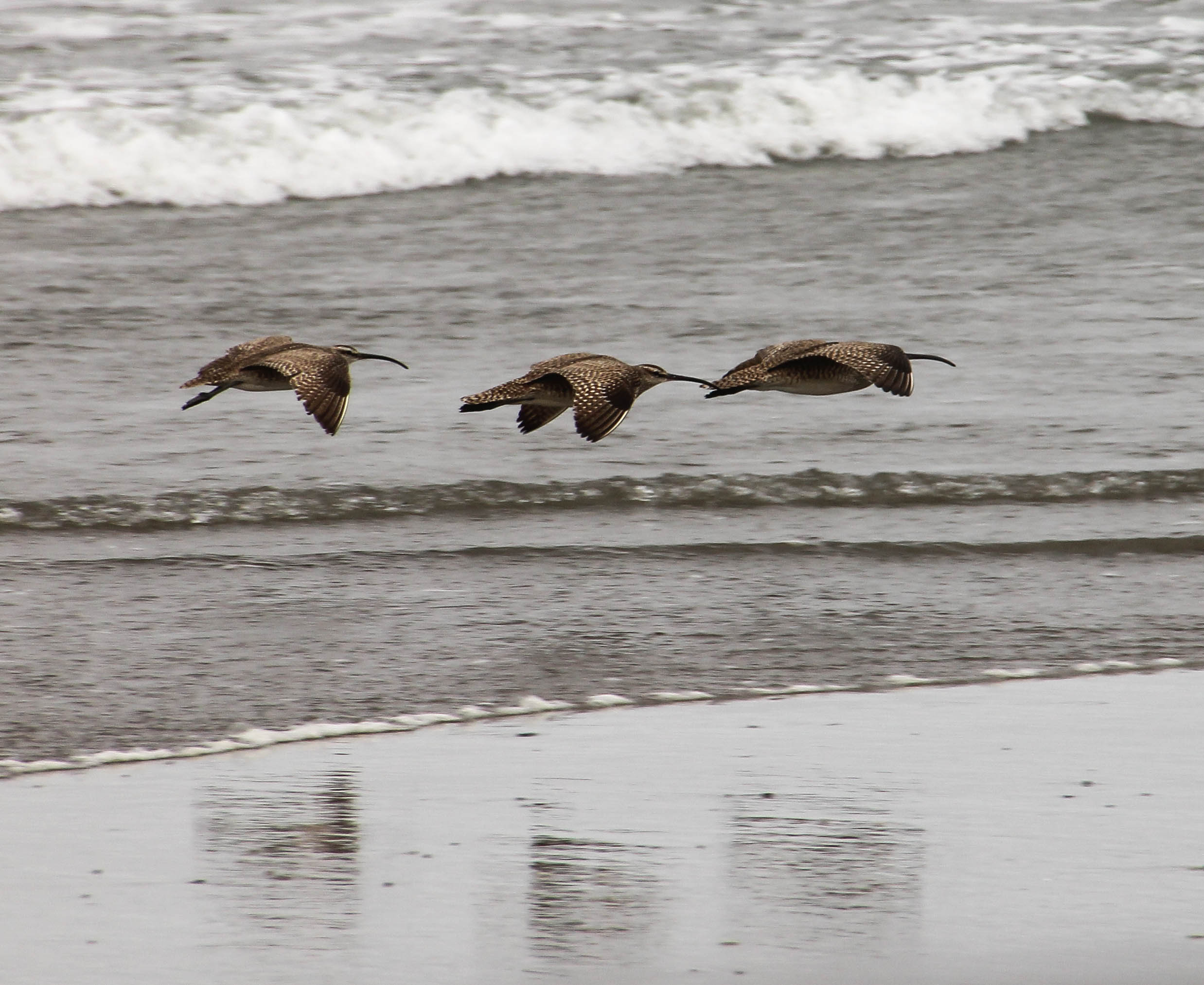
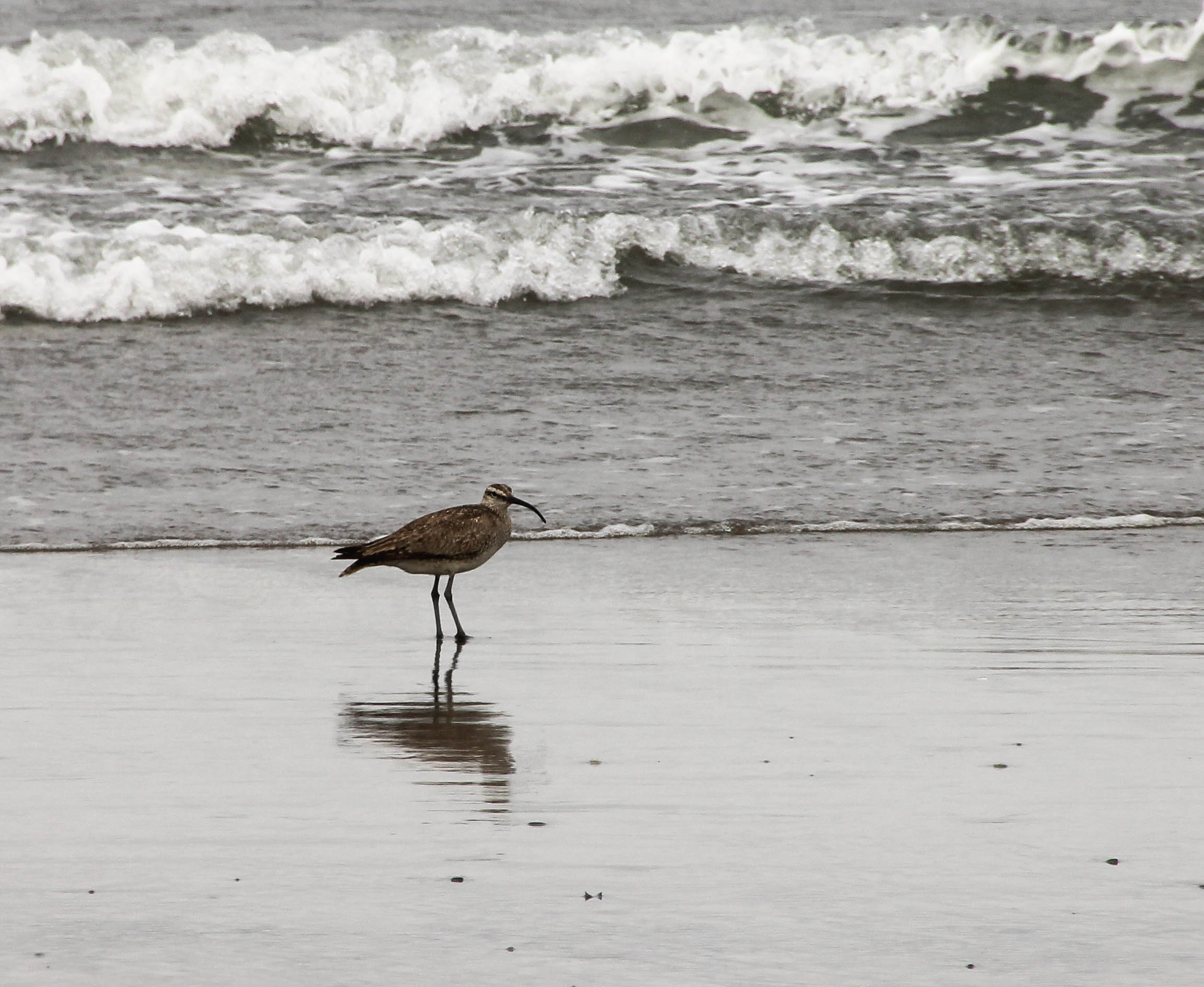
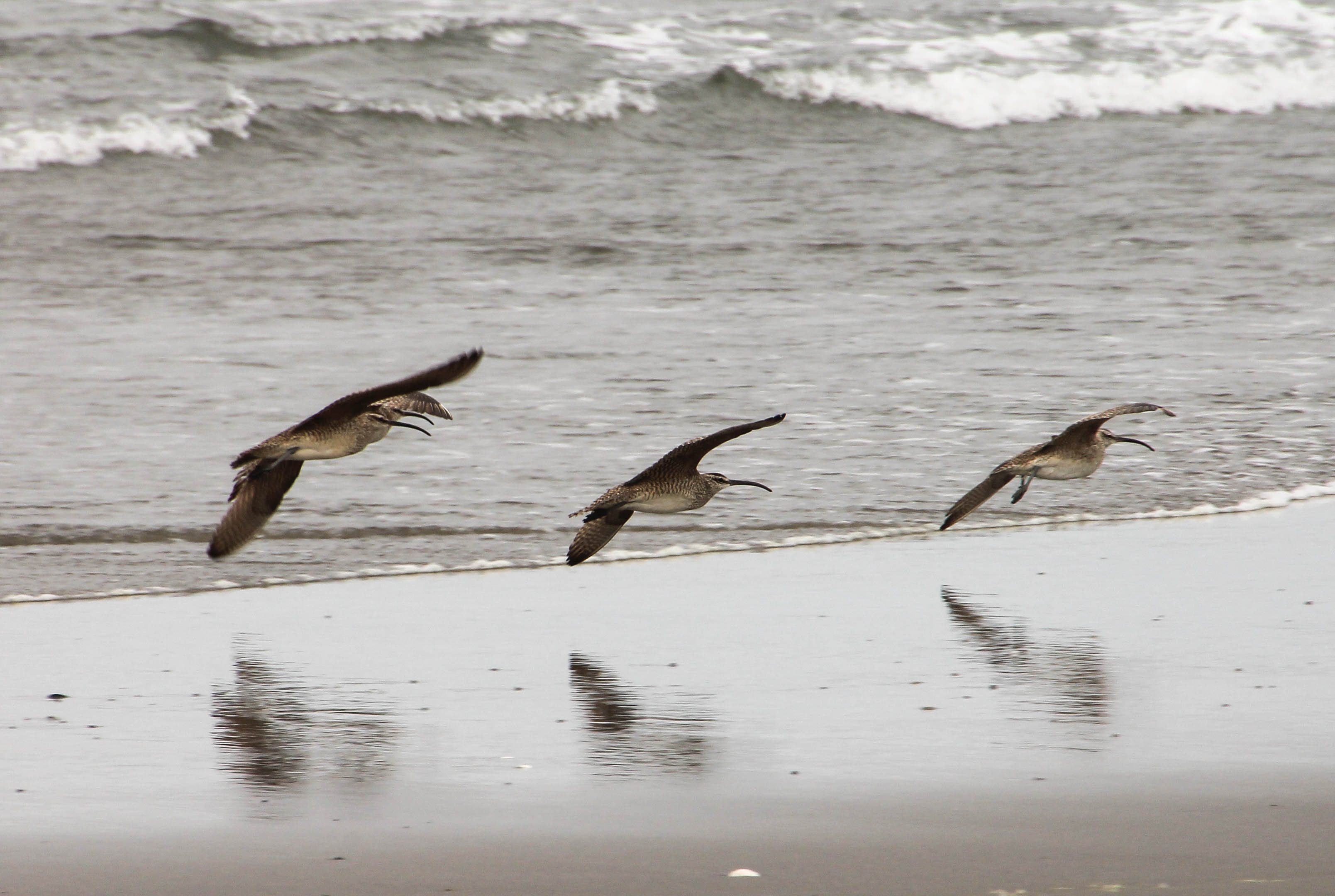
I am happy to share with you my sightings of these beautiful curlews. These photos were taken on a cloudy and windy day, July 14, 2014, while walking on the beach at Bullards Beach State Park in Bandon, Oregon.
Watching
The Whimbrel is the commonest curlew, which escaped the destruction suffered by other curlews at the hands of early gunners, probably because the species migrates chiefly over water. Its nesting habitat in Canada and Alaska hasn’t been disturbed so its numbers are stable. It is easily identified by its large size, distinctive head stripes, and decurved bill. It is a monogamous breeder and occasionally nests in loose colonies. (info taken from several birding books)
GlidingSearching
This was my first sighting of these Whimbrels, making it number 369 on my Birding Life List. It was exciting seeing these Whimbrels searching for food and taking flight along the shore of the Pacific Ocean. It was an extra special walk, this July day, because hubby and I were were accompanied by friends.
`Black, relatively long sharp-pointed bill
`Black legs
`Contrasting reddish-brown markings on shoulder
`Reddish brown on crown and ear patch
`Feeds on crustaceans, mollusks, worms and aquatic insects
`Nests on moist tundra or mossy slopes
Fishing
Western Sandpiper Art
New one! – #372
Photos taken at Bullards Beach State Park, Bandon, Oregon
Bullards Beach State Park
Joining Charlotte at Prairie Birder at http://prairiebirder.wordpress.com
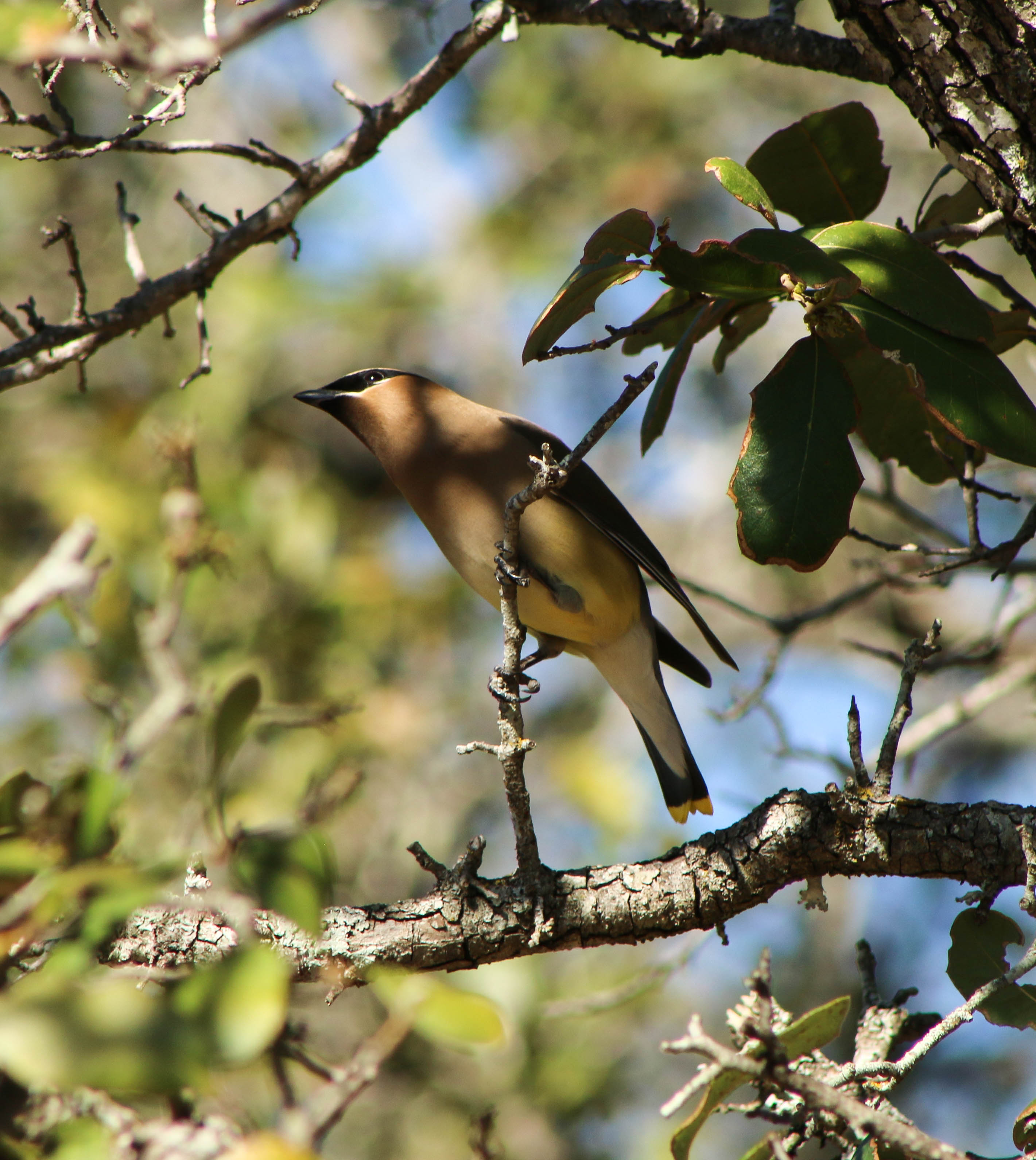
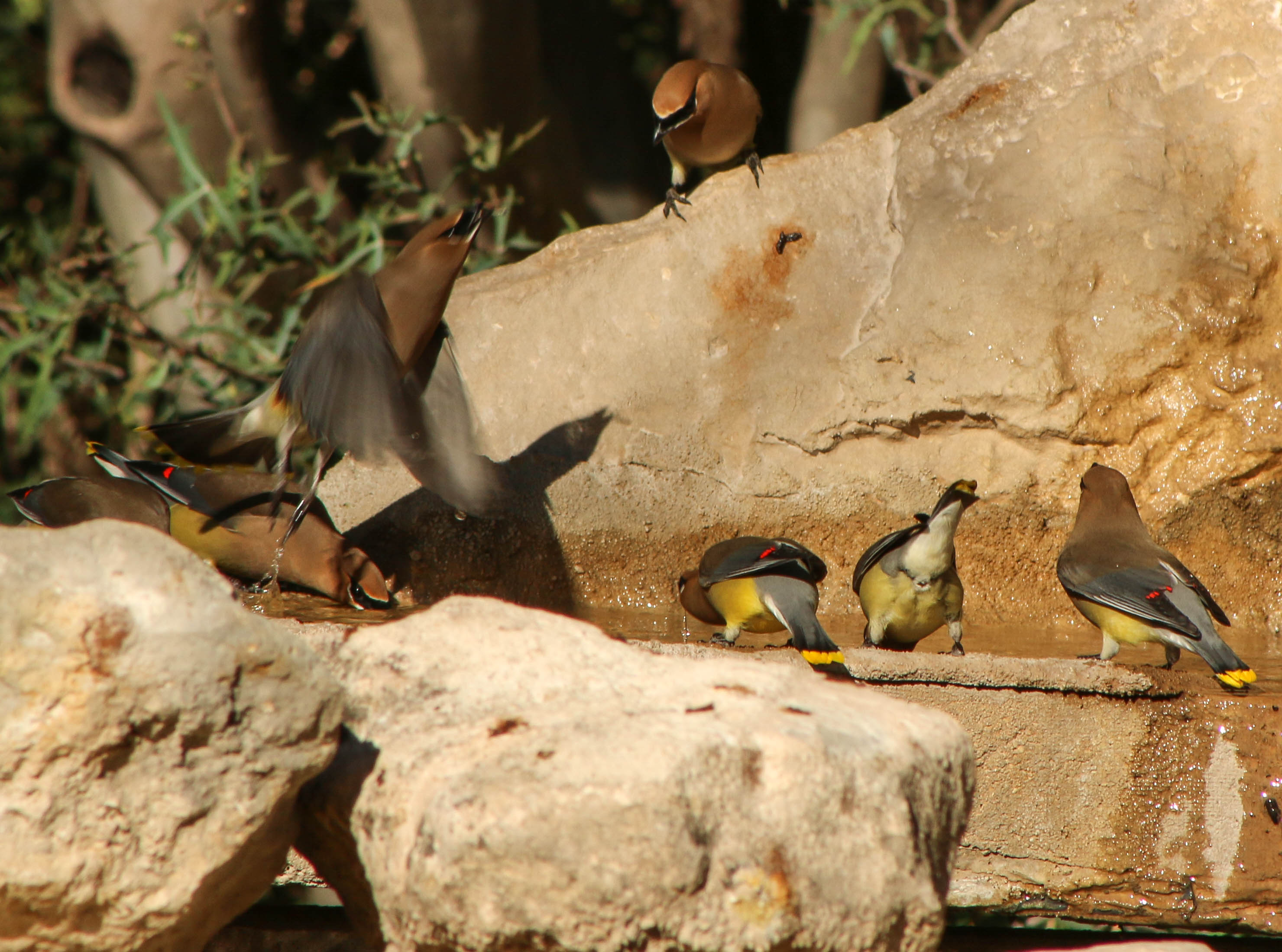
We have never seen so many Cedar Waxwings in one location. It was fun watching them come in for a drink. In all the photos I captured of them drinking, there was always one Cedar preforming the task of “lookout”. Photos taken in April 2014 in South Llano State Park, Junction, Texas. I was using my Canon 70D with Canon EF 75-300mm 1:4-5.6 lens.
What a beautiful little bird measuring only 5 1/4 to 5 3/4 inches
Today’s Feathered Friend:
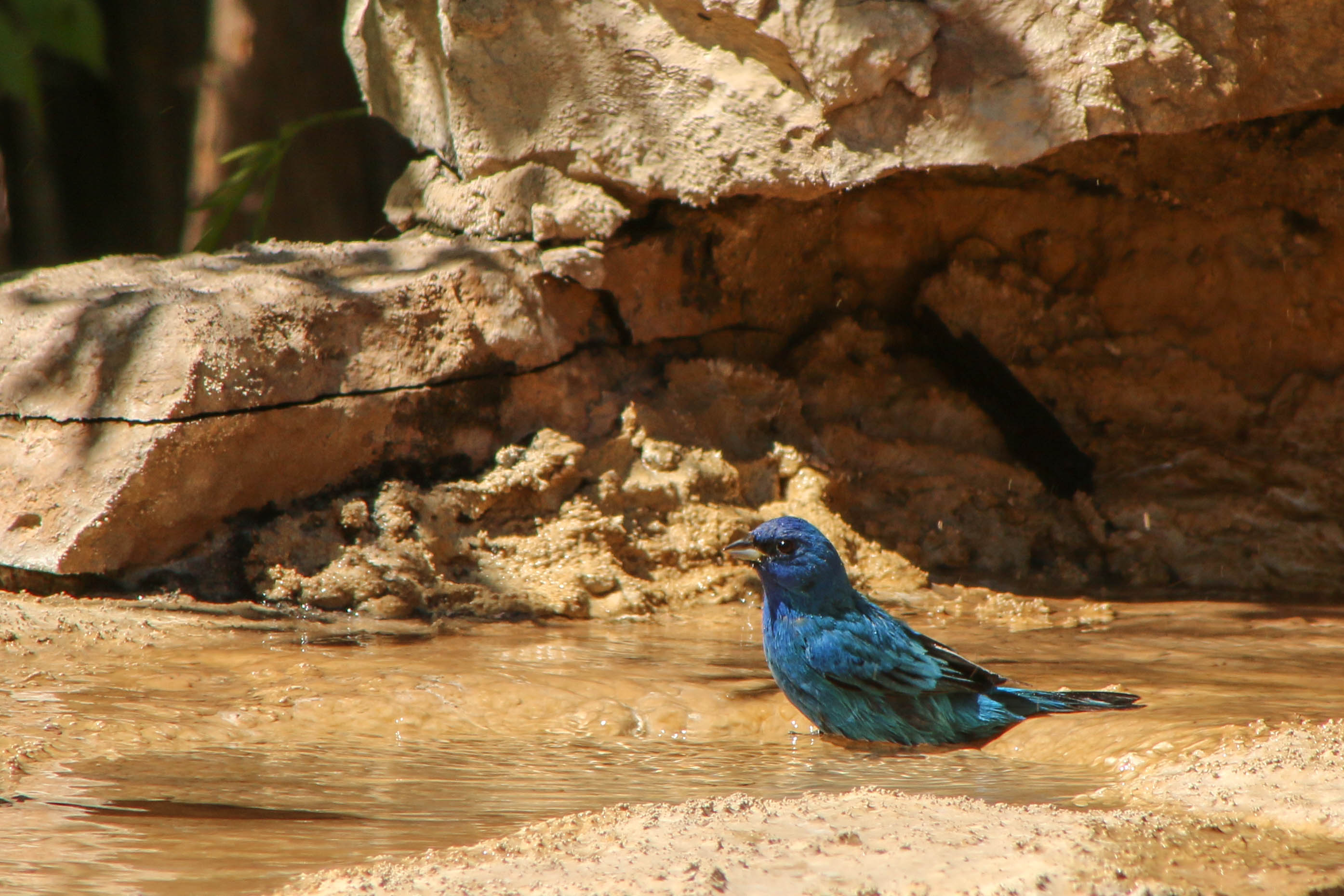
Indigo Bunting
Male:
`deep-colored bright blue overall (breeding plumage)
`only North American small finch to appear blue all over
`blue-purple head
`dark blue to black lores
`blue edging to blackish wings and tail
`dark gray conical bill
Female:
`plain, but beautiful brown
`two tawny buff wing bars
`short, gray, conical bill
`blue-edged feathers on wings and tail
Facts:
`populations are expanding with the creation of disturbed habitat after logging, highway and power line construction and from farmland abandonment (yeah to expanding)
`likes forest edges, roadsides, hedges, dry brush lands, orchards, open woods, creeks and rivers
`eats grasshoppers, beetles, weevils, aphids, cicadas, cankerworms, span worms, flies, dandelion seeds, aster, thistle, grasses, grains, berries and more
`nests in raspberry and other shrubs
`song is a sweet-sweet, where-where, here-here, see-it/see-it (pretty melody)
`many are killed, while migrating at night, striking power lines and tall buildings (wind farms next?)
`neotropical migrant, flight speed measured at 20 m.p.h
`common hosts to cowbird parasitism 😦
Deep blue with purple sheen on head
“Splish-Splash I’am taking a bath”
**If you want to learn more about the Indigo Bunting, please go to The Audubon Society Encyclopedia of North American Birds, Smithsonian Handbooks, Birds of North America and Stokes Field Guide to Birds. I used these sources for my information.
Artsy background highlighting a beautiful Indigo Bunting (I played with the background in this photo.)
Added to my Birding Life List
on o7/12/88
Sky Rocket Road, Loveland, Colorado
(with my amazing birding mentor- Ann Means)
Photos taken at South Llano River State Park in April of 2014 while sitting in a bird blind. I was using my Canon 70D with Canon EF 75-300mm 1:4-5.6 lens (no stabilization).