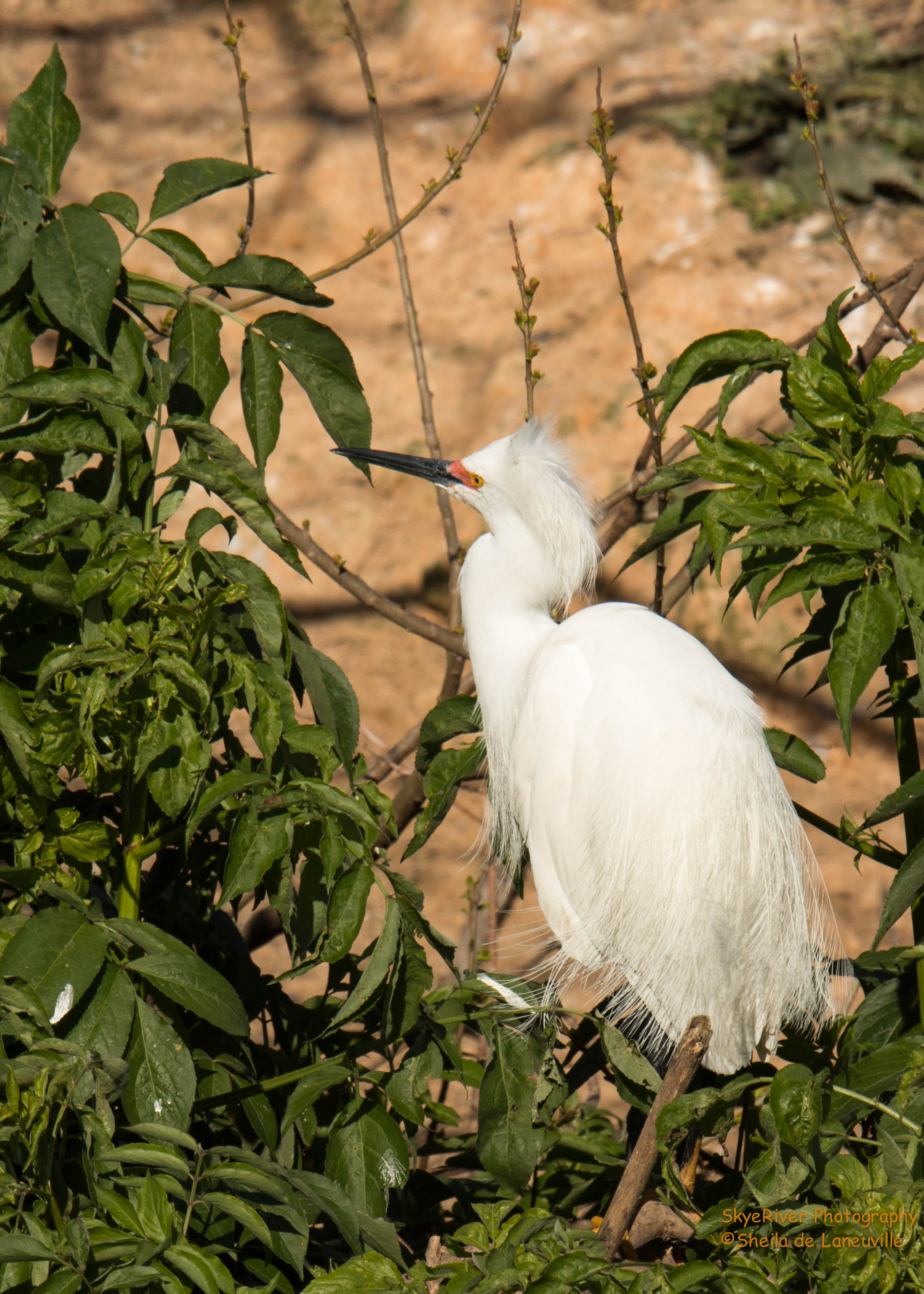
I don’t know why I left The Rookery with so few Snowy photos. The Neotropic Cormorants, Great Egrets and Roseate Spoonbills outnumbered the Snowy Egrets (while we were there). I don’t remember seeing that many Snowy Egrets.
I couldn’t figure out what this one was doing; perhaps looking for another stick.
The Cormorants and the Great Egrets were well on their way to building their nests, sitting on them and a few had laid eggs, while the Snowy Egrets and the Spoonbills seemed to be just hanging out. I think the Spoonbills had just arrived at The Rookery. We were there on March 24, 2015 . I understand life there is hopping these days! What fun it would be to see the chicks!
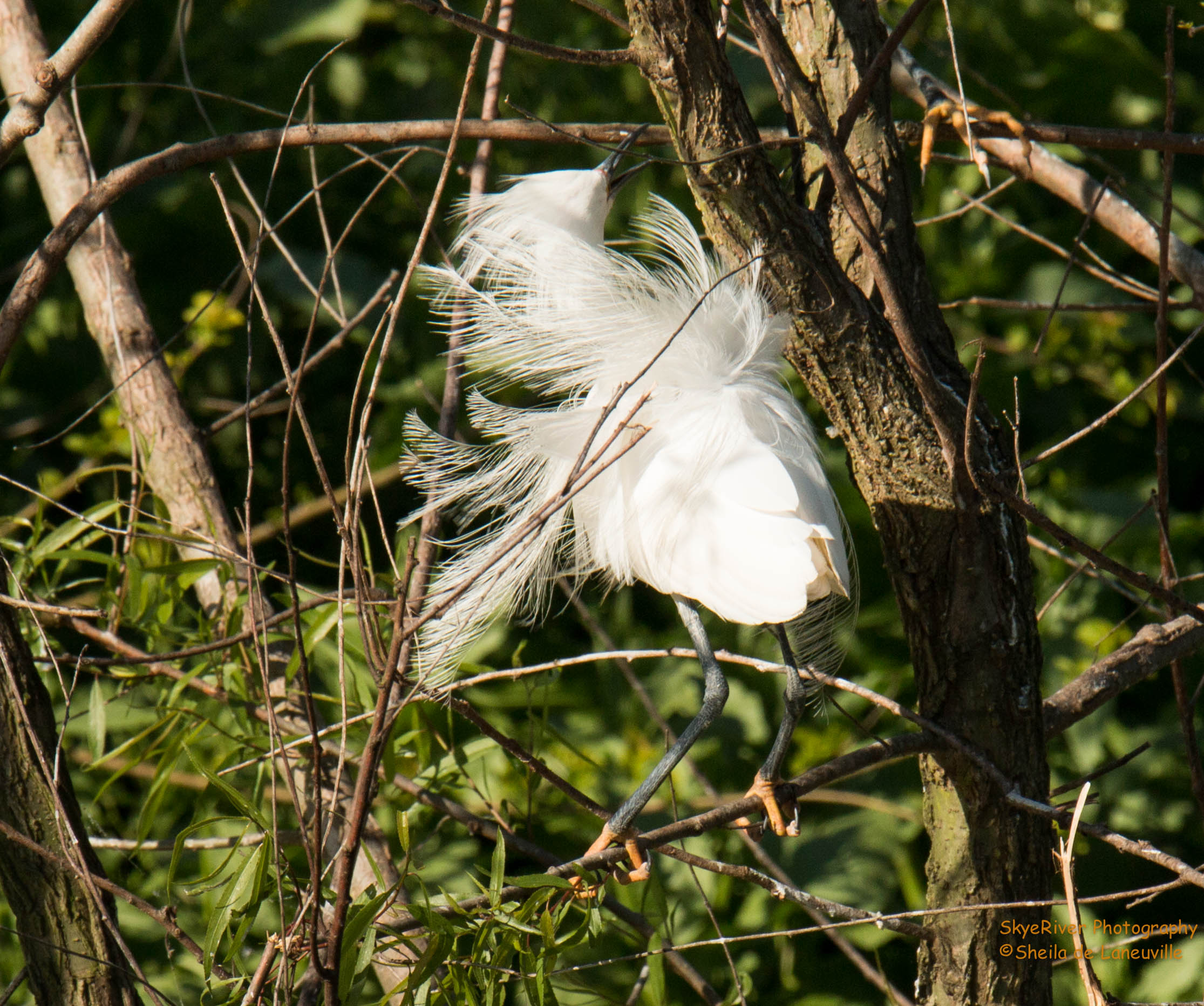
A dispute.I guess the only thing he accomplished was to mess up his feathers.
Eloquent songsters of open marshes and woodlands, the thrushes include many familiar species. With narrow notched bills they feed on insects and fruit.
Eastern Blue Bird (male)Throat, sides of neck and breast are a chestnut color. Belly white. Males are deep blue above, females grayer.Nest in holes in trees and posts, and in nesting boxes.
Bluebird Conservation:
Eastern Bluebird populations increased by almost 2 percent per year between 1966 and 2010, according to the North American Breeding Bird Survey. Partners in Flight estimates the global breeding population at 22 million, with 86 percent spending part of the year in the U.S., 22 percent in Mexico, and 1 percent breeding in Canada.
They rate a 7 out of 20 on the Continental Concern Score and they are not on the 2012 Watch List. Eastern Bluebird populations fell in the early twentieth century as aggressive introduced species such as European Starlings and House Sparrows made available nest holes increasingly difficult for bluebirds to hold on to.
In the 1960s and 1970s establishment of bluebird trails and other nest box campaigns alleviated much of this competition, especially after people began using nest boxes designed to keep out the larger European Starling. Eastern Bluebird numbers have been recovering since.
For more information on this beautiful thrush, please visit this web-site – http://www.allaboutbirds.org/guide/Eastern_Bluebird/id
~Sharing with Charlotte at Prairie Birder for Feathers on Friday
Lake Louisa State Park, located near Clermont, Florida, has many acres of old-growth Orange Groves, some bordering the main road into the park. Presently, these groves are non-producing, but provide great habitat for birds and other wildlife.
Recently, some of these trees have been uprooted and stacked in piles as you can see in the photo below.
Uprooted Orange Trees. Rows and rows of them.
I wish the park’s management will allow some of the piles to remain for the wildlife seeking refuge, but I tend to believe they won’t. Better yet, why don’t they plant new trees in their place. They don’t have to replant orange trees.
This is what the field looked like on December 26, 2014 as they began uprooting the trees..
Anyway “Lets Talk Turkey”
Late one evening about one week ago, leaving the guys behind, my friend Karla and I decided to jump in the car and head out in search of a pair of American Kestrels. We had been seeing them daily, when driving in and out of the park.
The Kestrels had been hanging around some of these mangled piles of orange trees, perhaps getting ready to build a nest. They would sit on one of the tallest points of the stack, probably looking for food. I wanted to capture a photo of them.
On this particular evening we didn’t see the American Kestrel pair, I think it was too late in the day, but we did see this gorgeous couple, along with seven other females, coming out of the woods to forage before roosting for the night. They were pretty far away so my photos aren’t the best. The guys missed out!
To learn more about our Wild Turkeys go to http://animals.nationalgeographic.com/animals/birds/wild-turkey/.
Wild Turkey Pair
Until Next Time
Stay Frisky
Maybe she is saying, “pick me instead of her”.
I am sharing this post with Eileen, Viewing nature with Eileen for her Saturday’s Critters at http://viewingnaturewitheileen.blogspot.com/2015/02/saturdays-critters-63.html





 Wolf Song Blog