Dead Horse Ranch State Park, Cottonwood, AZ, October, 2017
Dead Horse Ranch got its peculiar name in the late 1940’s from its previous owners, the Ireys family from Minnesota. They were looking to buy a ranch and on their tour they discovered a large dead horse lying by the road outside of the property. After two days of viewing ranches, Mr. Ireys asked the kids which ranch they liked the best, and they all agreed “the one with the dead horse, dad!”. Acquired in 1973 by AZ State Parks, the Ireys family made it a condition of the sale that the park retain the name Dead Horse Ranch.
We traveled from the Grand Canyon to Cottonwood, AZ staying one week at Dead Horse Ranch State Park. We have been here many times, but it has been several years since our last visit. We throughly enjoy our stay.
Hiking, mountain biking, fishing, horseback riding are just some of the activities one can enjoy at DHRSP.
After an arduous time getting ready to leave home, and our tourist mode adventure at the Grand Canyon, we were ready to settle into a more relaxing routine.
Howard worked on a few coach maintenance items, setup an antenna and operated his ham radio, and he even got to jog a few times. I enjoyed hiking, birding and photographing this lovely area.
~Mornings:
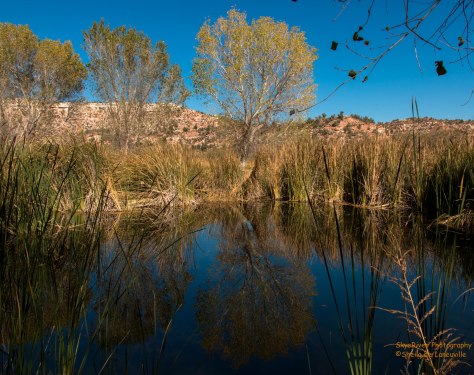
`Hiking around the Lagoons…
Still Waters
~
~
Looking through the reeds.
~
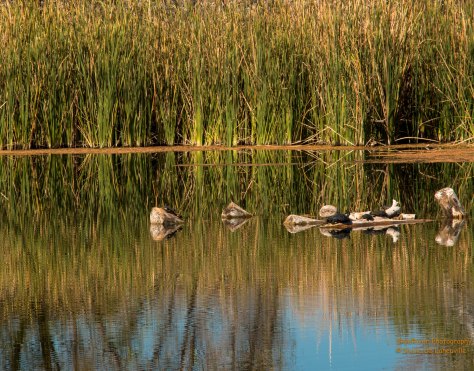
Relaxing on a log.
~
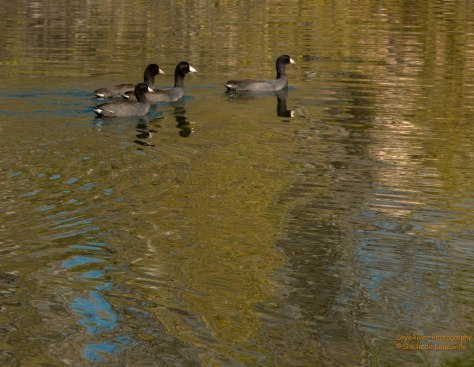
A leisurely swim.
~
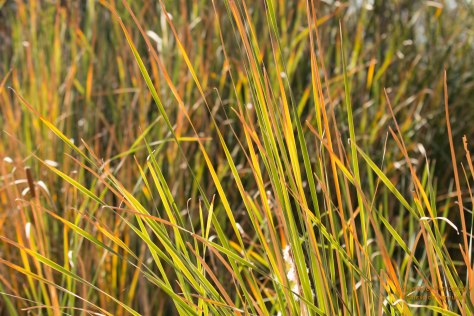
Sunlight through the reeds.
~
A Cloud Sulphur
~
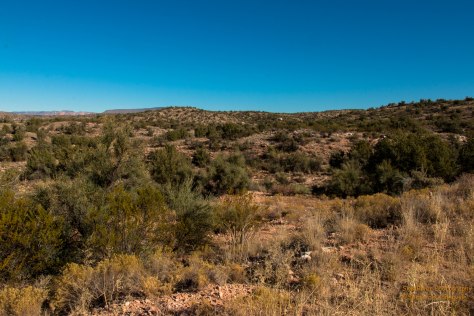
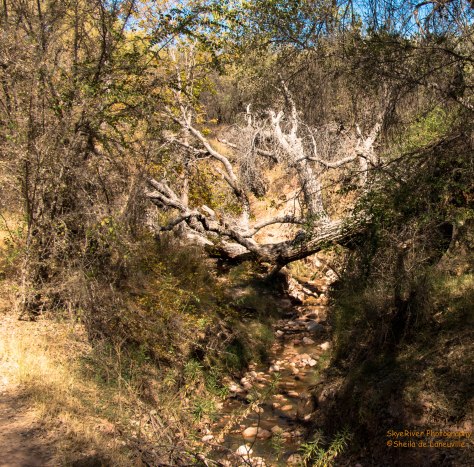
`Walking a rocky trail…
Miles of trails for hiking, mountain biking and horseback riding.
~
The Verde River
~
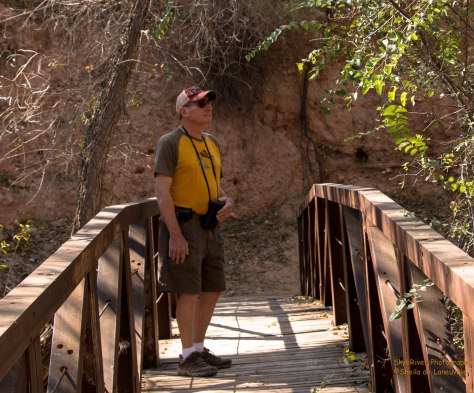
A birder along the trail.
~In between – Touring and Eating:
Old Town Cottonwood seems like it has come back to life since our last visit. Many of the old buildings have been renovated and are now occupied by beer and wine tastings shops, antiques stores, galleries and more.
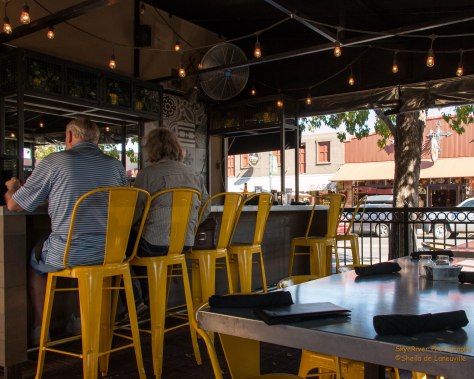
There are also several new restaurants. We ate at the Tavern Grill, enjoyed sitting outside on the covered patio, and the food was very good!
One of those Micro Brews was mine!Outside Patio at the Tavern Grill
If you like Mexican, you should try Pepe’s Cafe. I haven’t had Mexican food this good in a long time. It was Great!
One of our favorite places to eat in Cottonwood is Randall’s; they have been there a long time and the food is very good. Friday we enjoyed Fish Friday – our fav Catfish!
~Evenings:
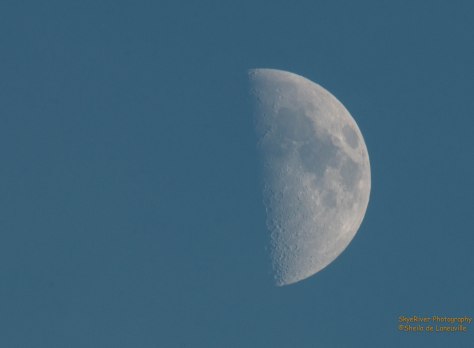
Waxing Moon
~
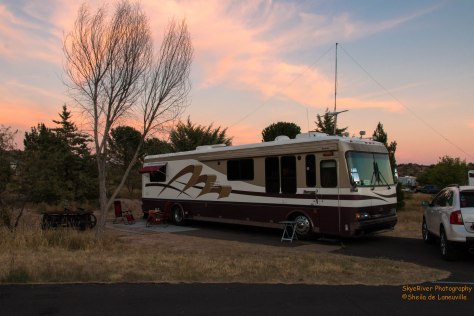
Rambling Rose at Sunset, Site 76 (notice Howard’s ham antenna)
~
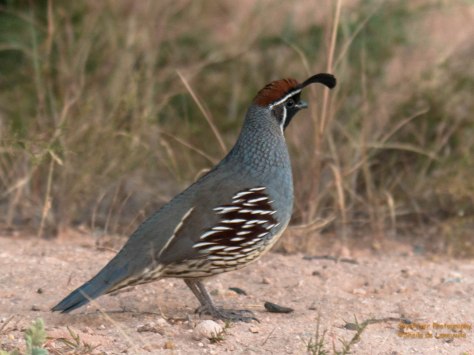
The Gambel’s quail (Callipepla gambelii) is a small ground-dwelling bird in the New World quail family. It inhabits the desert regions of Arizona, California, Colorado, New Mexico, Nevada, Utah, Texas, and Sonora; also New Mexico-border Chihuahua and the Colorado River region of Baja California.
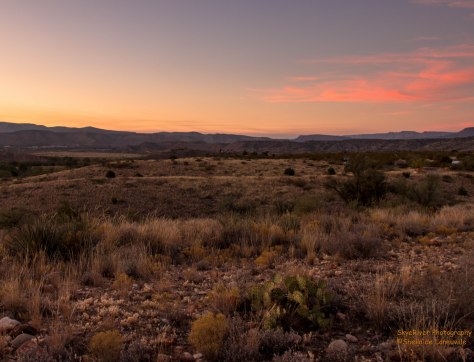
Gazing out over the canyon, the last of the sun’s rays highlight the rocky cliffs along the canyon. One can’t help but be in awe of the explosion of color being offered in the minutes before the sun descends over the western horizon. It truly is a sight to behold.
Just as this day came to an end, our trip to the Grand Canyon came to an end.
Setting sun, October 21, 2017
~
~
The fading light leaves it mark on the cliffs turning stone into colorful spires, and this trip leaves magical memories in my mind.
~Next up Dead Horse Ranch State Park in Cottonwood, AZ.
The Grand Canyon is one of the seven natural wonders of the world, along with Mount Everest in Nepal, Victoria Falls in Zambia/Zimbabwe, Australia’s Great Barrier Reef, the Northern Lights, Paricutin Volcano in Mexico and Harbor of Rio de Janeiro in Brazil. The Canyon attracts 4.5 million visitors from all over the world annually.
The Grand Canyon is home to 70 species of mammals, 250 species of birds, 25 species of reptiles and five species of amphibians.
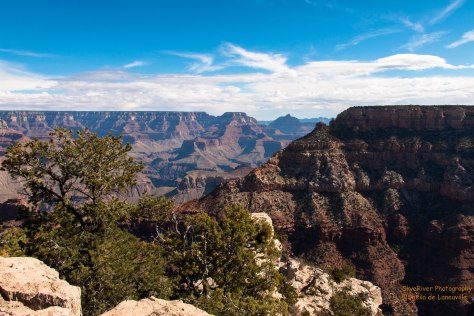
Grand Canyon, South Rim, as we walk east.
Howard and I walked about five to six miles each day while visiting the Grand Canyon. We preferred the east end of the South Rim Trail. The longer we walked the trail, the fewer people we encountered. The terrain was different going east in that it was more forested. I loved this area. A perfect environment for birds and wildlife.
Taken in an area east of Mather Point.
~
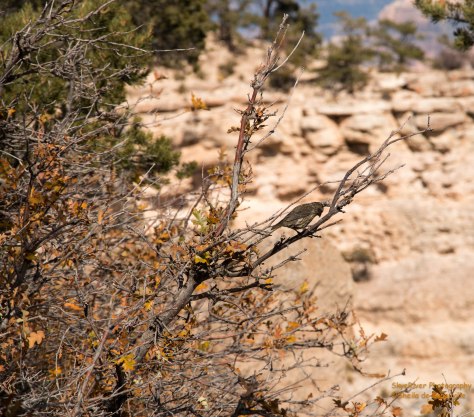
You can’t imagine my delight when I downloaded the photo below. I haven’t seen this bird in years. It is a Red Crossbill. If you zoom in on the photo take a look at its bill.
Red Crossbill
~
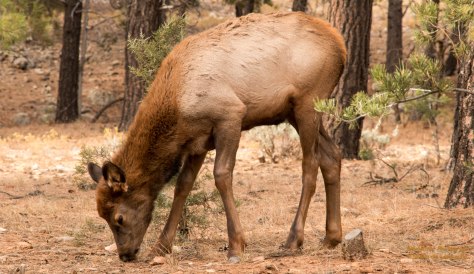
Elk (looks like a first year)
~
~
Junco, Gray-headed
~
~
~
~
Howard and I were walking along the South Rim Trail near the El Tower Hotel and spotted this Green-tailed Towhee looking for food – scratch, scratch, scratch! They are beautiful and fun to watch.
Green-tailed Towhee
~
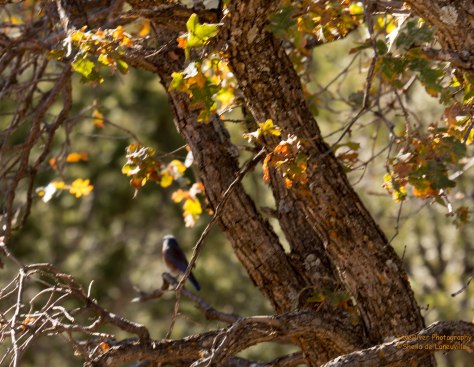
One evening we were walking the trails around the RV park. There were lots of Western Bluebirds in the area. In fact, I tried to get a photo of them drinking from a faucet, but someone walked by and they flew. This Western Bluebird, in the photo below flew before I could manually focus on her, but I like the photo.
Western Bluebird
~
Ravens:
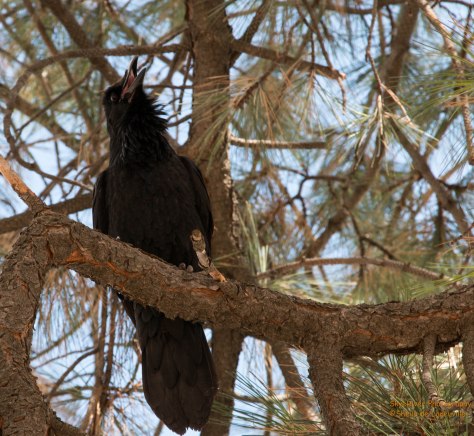
I never get bored watching these intelligent birds. I truly believe this Raven was mimicking a barking dog. I heard a dog barking for several minutes before I heard the Raven. I remember thinking, “what in the heck is making that noise”.
Barking? Note the wedge-shaped tail. This is how you can ID the Raven.
~
He looks happy with himself!
~
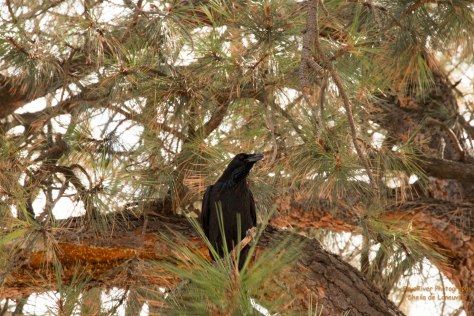
This Raven was sitting high up in a tree and “talking” away. I saw a young girl, about 11 years old with her phone, trying to get a photo of him. She was shooting into the sun and through a lot of branches. I walked over to the tree and called her to some stand where I was standing. I was happy to see her excitement in seeing this bird. I hope her photos came out okay!
~
Soaring
~
~
There are approximately 200 species of trees and shrubs in Grand Canyon National Park. Most of these are found in the higher elevations of the park, on the South and North rims. Some of the tree species include the white fir, Engleman spruce, blue spruce, Douglas fir, corkbark fir, ponderosa pine, Utah juniper, alligator juniper, Colorado pinyon, quaking aspen, Fremont cottonwood, Gambel oak, and Arizona walnut.
~
Birds I observed at the Grand Canyon, South Rim. I was very surprised at the number of birds there were in the area.
`Northern Flicker Red-shafted
`Hairy Woodpecker
`Scrub Jay
`Pinyon Jay
`Stellar’s Jay
`Common Raven
`Mountain Chickadee
`White-breasted Nuthatch
`Red-breasted Nuthatch
`Pygmy Nuthatch
`Western Bluebird
`American Robin
`Green-tailed Towhee
`Spotted Towhee
`Juncos
`White-crowned Sparrow
`Red Crossbill
~
Howard had a fun time taking panoramic photos with his iPhone.
Howard checking out his panoramic photos!This header photo is one of Howard’s gorgeous panoramic photos!
For some reason, I felt compelled to visit the Mule Barn, located near the Village along Village Loop Drive. I had expectations of seeing a few mules and was pleasantly surprised to see a Mule Train coming back to the barn. I haven’t ever seen a “Mule Train” tethered together before.
Mule Train
~
What does the name “mule” mean?
The word “mule” can be used for any hybrid, and is a cross between two species of equine: the horse or pony (Equus caballus) and the domestic donkey (Equus asinus). The term “mule” is used for either the cross of male donkey on female horse, or the cross of female donkey on male horse, although the latter cross is more correctly known as a “hinny.” Mules and hinnies each have one horse and one donkey parent, however the two crosses generally differ from each other in appearance and stature, and—to some extent—temperament. (information taken from Lucky Three Ranch.
~
Returning to the barn.
~
Mule Barn
~
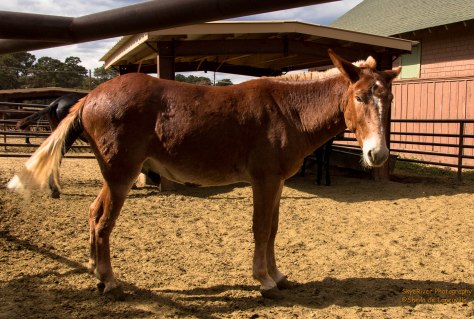
The mule in the photo below was turned out into a corral. The section of fence where Howard and I were standing didn’t have any “Don’t Pet the Mules” signs. So, being the animal lover that I am, I began petting this friendly mule. He came right up to the fence and seemed to enjoy the attention I was giving him. I was totally ignored by three other mules in the same corral.
After giving him lots of love, we continued on our walk along the path next to the corral, it was then that I noticed the signs “Don’t Pet the Mules”. Oh well, too late! {grins}
Pack Mule
~
They just look so sad, but how would I know for sure.
~The information below was taken from the Lucky Three Ranch:
What are the physical characteristics of the Mule:
A distinctive bray.
Long ears.
Short, upright and thin mane.
Hair only on the end of its tail.
Tends to look more horse-like.
May come in a variety of colors.
Hooves are narrow and box-like, unlike the horse’s hoof. They’re upstanding, and made for rock and mountain climbing. They are tough and elastic, non-chipping and can grow to long lengths when the animal is on soft ground and the hooves are left untrimmed.
Long body with long, wiry muscles.
Short and straight back. Lacks upstanding withers and is excellent for packing and weight bearing.
Bone is dense and hard.
Gestation is 12 months, whereas the gestation period for a horse is 11 months.
Usually has a white belly and muzzle, and circles around the eyes.
Colors are much like that of a horse.
They can come in more colors than a horse, even an Appaloosa.
Mule’s conformation falls somewhere in between that of the donkey and that of the horse.
Mules inherit best traits from both its sire and its dam.
Mules get their athletic ability from the horse, while strength and intelligence come from the donkey.
What are the mental characteristics of the Mule:
Highly intelligent, alert, curious and affectionate, when not worn down by bad conditions (i.e., cruel treatment, bad shelter, bad food and water or overwork).
Quick to learn. A well-trained mule is calm, tolerant, loyal, affectionate, obliging and patient.
Sensitive. Mules and donkeys might be mistaken as being stubborn when they’re actually afraid or confused.
Has common sense and not prone to panic or carelessness.
Can recognize danger.
~
~I don’t believe I could ride a mule down into the canyon. However, lots of people do.~
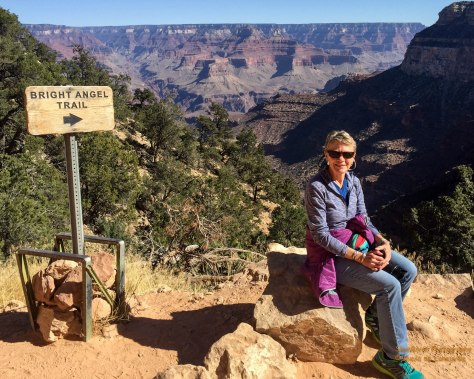
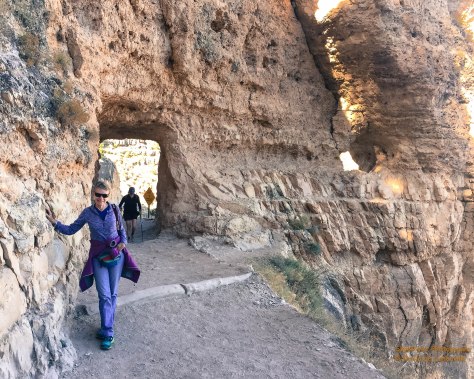
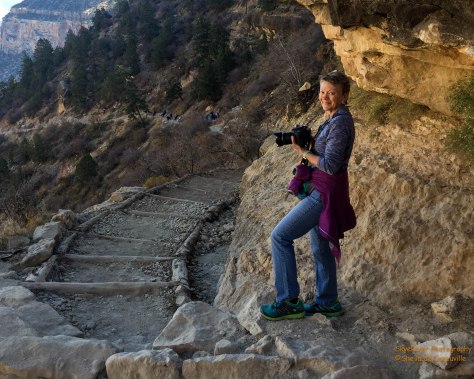
The Bright Angel trail head.Not too far down yet; but a deep drop-off.Going downHoward along the trail.A view from the trail. Notice the trail below on the right.
Howard and I decided that we were going to take a hike down into the canyon. For three days we watched others descending into the canyon. We wanted to experience the adventure for ourselves. We knew we couldn’t go too far; a mile or two would do.
Grand Canyon, 10/2017. Going down into the canyon. We did it!

















 Wolf Song Blog